
Grady County Release Date Types
Release date can mean very different things. At the Grady County Detention Facility, a person held before trial often has no sentence end date. Release may occur when bond is posted and accepted, a judge enters an order, charges are dismissed, a hold is lifted, or another agency takes custody. The exact event and timestamp belong in the jail release record and related court order.
Georgia prison records use other terms. A Maximum Release Date, or MRD, is tied to the end of the state sentence calculation. A Tentative Parole Month, or TPM, is the month when the State Board of Pardons and Paroles expects to complete final review and may set a parole release date. TPM is conditional. It is not a promised day of release.
A discharge means the relevant sentence or supervision has ended. Parole means conditional release from prison into community supervision. A transfer means custody moved to another authority. None of those terms should be substituted for another.
Find Grady County Release Timing
Start with the custody system, not the date. GDC's public form is useful for a state prisoner, but it is not a full archive of local bond releases. The Grady sheriff and court are the proper sources for a county jail case.
- Confirm whether the person is in the county jail, GDC custody, federal custody, or another agency.
- For a local booking, call the sheriff at 229-377-5200 and request the release timestamp, type, authority, booking number, and transfer destination.
- Check the Grady County Clerk of Court for the bond order, disposition, sentence, dismissal, or later amendment.
- For state custody, open GDC Find an Offender, accept the disclaimer, and search by GDC ID or full name.
- Use the direct form's institution and sentence-status options, then compare any MRD or release indicator with parole information.
The GDC query includes “GRADY COUNTY JAIL,” “Max Prison Term Ending Next 15 Days,” and “Released In The Past 15 Days.” Those controls apply to GDC-linked custody. They do not turn the state form into a county release ledger.
GDC's Performance Incentive Credit page shows how state credits can affect TPM or MRD.
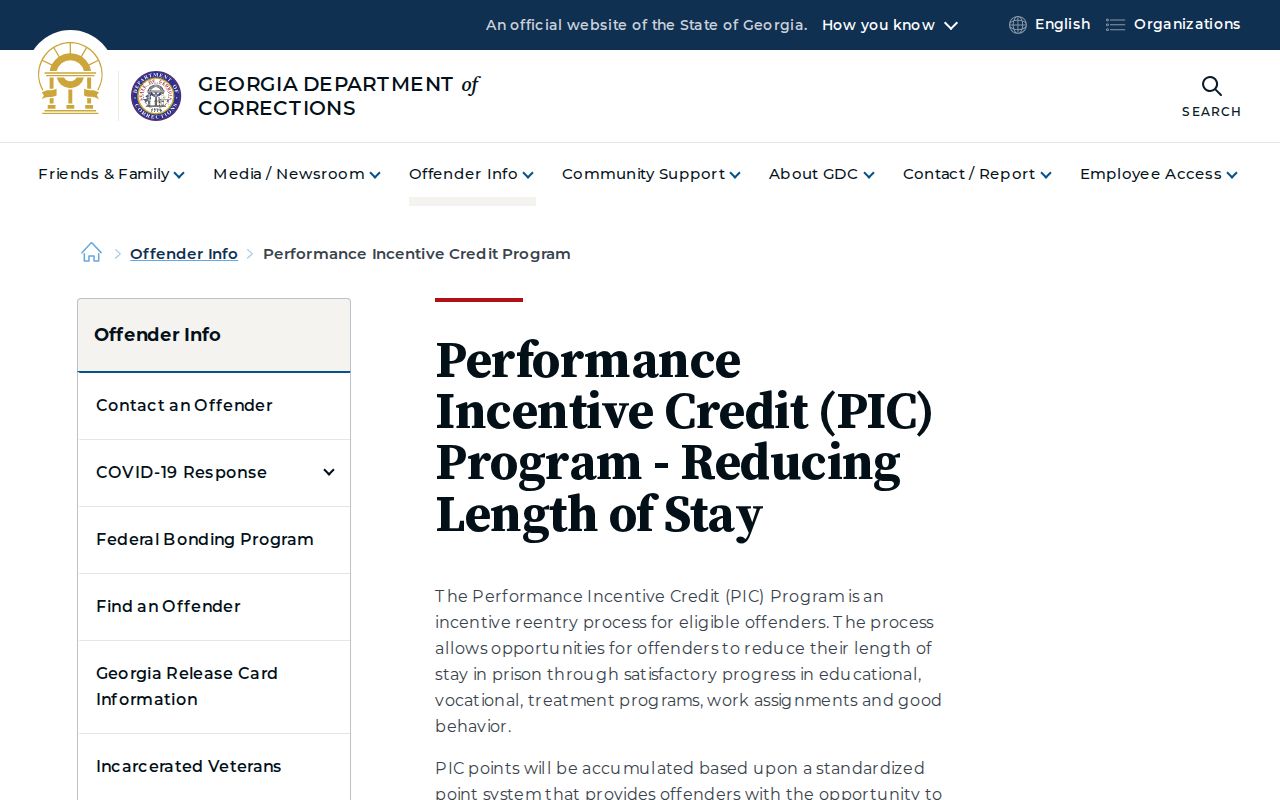
The captured GDC material applies to eligible state offenders, not to a Grady County pretrial bond release.
Georgia Credits and Grady Releases
O.C.G.A. 42-5-101 authorizes work incentive credits tied to education, vocational progress, satisfactory work, and behavior. GDC describes standardized PIC points for case-plan work, education or vocational gains, and some assignments. Eligible offenders can accumulate up to 12 points and may receive one to 12 months off TPM or MRD.
GDC lists exclusions that include death-sentence offenders, sentences of two years or less, non-parole-eligible or minimum-mandatory cases, and life sentences. Credits do not guarantee release. Program completion, conduct, sentence calculations, and Board review still matter.
O.C.G.A. 17-10-6.1 restricts parole and early release for listed serious violent felonies. The Parole Board states that covered non-life offenses with crime dates on or after January 1, 1995 are not eligible for parole consideration. Life-sentence timing also changes with the offense date.
Note: No public Grady County jail good-time formula or weekend-release policy was found, so local timing must come from the jail and court record.
Why Grady Release Dates Change
Projected dates move because legal and administrative inputs move. A state prison calculation and a county jail release order respond to different events. Always ask which office changed the date and why.
| Reason | Possible effect |
|---|---|
| PIC credit or program work | May reduce TPM or MRD for an eligible GDC offender. |
| Disciplinary report | May delay or cancel a TPM and affect credit. |
| Board reconsideration | Can change a prior parole decision up to release. |
| Sentence recalculation | Changes the controlling state maximum date. |
| Detainer or transfer | May end one custody record while another agency takes custody. |
| Court order or bond | Can cause or delay release from the Grady County jail. |
Most parole-eligible inmates may become eligible after serving one-third of a prison sentence, according to the Georgia parole process, but eligibility is not release. The Board may set a TPM or deny parole. It may also require a program or work release first.
Confirm Grady County Actual Release
A local release becomes verifiable when the Grady County jail records the event. Ask for booking and release date and time, release type, releasing authority, case number, bond facts if relevant, holds, and transfer destination. A court docket can explain the order but is not the jail's custody timestamp.
For GDC, read the offender result and verify uncertain facts through Inmate Records and Information, PO Box 1529, Forsyth, GA 31029. A person shown as released may then appear in the Parolee Database or with DCS supervision. The Cairo DCS Field Office serves Grady County, but it confirms community supervision rather than the county jail's bond-out event.
A Grady County VINELink release check can provide a fast custody-change notice. It remains a notice, not the formal release record.
Georgia TPM and MRD Difference
Georgia's TPM/MRD split is the key release-date quirk. The Board's TPM explanation says a tentative parole month is not final. It marks the month for final review and possible setting of a parole date. Good conduct and required programs can remain conditions.
MRD is the maximum release date concept used in the state sentence. PIC may reduce either TPM or MRD for an eligible person, but the two fields answer different questions. TPM asks when parole review may lead to release. MRD concerns the maximum state term after the applicable calculation.
- TPM
- A conditional parole-review month, not a guaranteed release day.
- MRD
- The maximum release date in the GDC sentence calculation.
- Actual release
- The recorded event when the responsible agency ends or transfers custody.
- Detainer
- A basis for another authority to take or continue custody.
For a local Grady case, neither acronym should be imposed without a GDC-linked sentence. Bond acceptance, a court order, jail credit, sentence expiration, a lifted hold, or transfer pickup controls the event.
Grady State Parole Date Review
The State Board of Pardons and Paroles performs a final review at the TPM and may then set a parole release date. The Board can reconsider a prior decision until release. Misconduct can postpone or cancel the tentative month, and program completion or work release may be required first. For that reason, an eligibility date, TPM, and final parole date should be recorded as separate facts.
Serious violent felony rules require special care. The Parole Board identifies covered non-life offenses with crime dates on or after January 1, 1995 as ineligible for parole consideration. For life sentences, the research identifies different eligibility periods based on offense date, including fourteen-year and thirty-year periods in the relevant categories. The applicable judgment and Board record control an individual case.
After a state prisoner is released on parole, the Parolee Database and DCS supervision records may confirm the community status. The DCS Cairo Field Office serves Grady County. It does not calculate a county-jail bond release, and its supervision record does not replace the GDC discharge record.