
Grady County VINELink Coverage
Georgia VINE through VINELink receives custody and criminal-case information from participating agencies. Its strongest use in Grady County is a check on one known person, followed by an alert for release, transfer, or another custody change. Participation and retention depend on the agency feed. A Grady County Detention Facility booking may appear while active yet become hard to find after release. That does not erase the jail's booking and release record.
VINE is not one statewide archive of every person who has left a Georgia jail. It also is not the Federal Bureau of Prisons locator or the ICE detainee system. A local jail release belongs to the sheriff's record; a state-prison discharge belongs to the Georgia Department of Corrections; a parole decision belongs to the State Board of Pardons and Paroles. VINELink reports status supplied by a participating source and offers timely notice, but the source agency remains the place for formal proof.
The Grady County Sheriff's Office public channel points mobile users to its app, while the researched web pages did not show a durable recent-release table. That gap makes VINE useful, but not conclusive. Search it first when the person and likely custody agency are known. Then preserve the status text and check the result against the jail, court, or state record.
Search Grady County Release Status
Begin with enough detail to separate people who share a name. An agency or inmate ID is best. If only a name is known, use the full legal spelling and compare age and facility details when the result supplies them. Do not assume the first similar name is the correct person.
- Open Georgia VINELink and choose the person or offender search.
- Enter the full name or known identification number, then submit the search.
- Compare age, facility, county, and other displayed facts before opening a result.
- Read the current custody status and facility. Save the date and wording of any reported change.
- If no match appears, try an alias, alternate spelling, hyphenated form, or the possible receiving agency.
A missing result has several possible causes. The name may differ from the booking entry, the feed may lag, the record may no longer be retained, or the person may have moved to another custody system. For a broad agency-by-agency fallback, use the Grady County released inmate search paths. A current roster alone cannot prove release because a transfer also removes a name from local custody.
The manifest capture comes from the official service. View the live Georgia VINE search before comparing it with the captured layout.
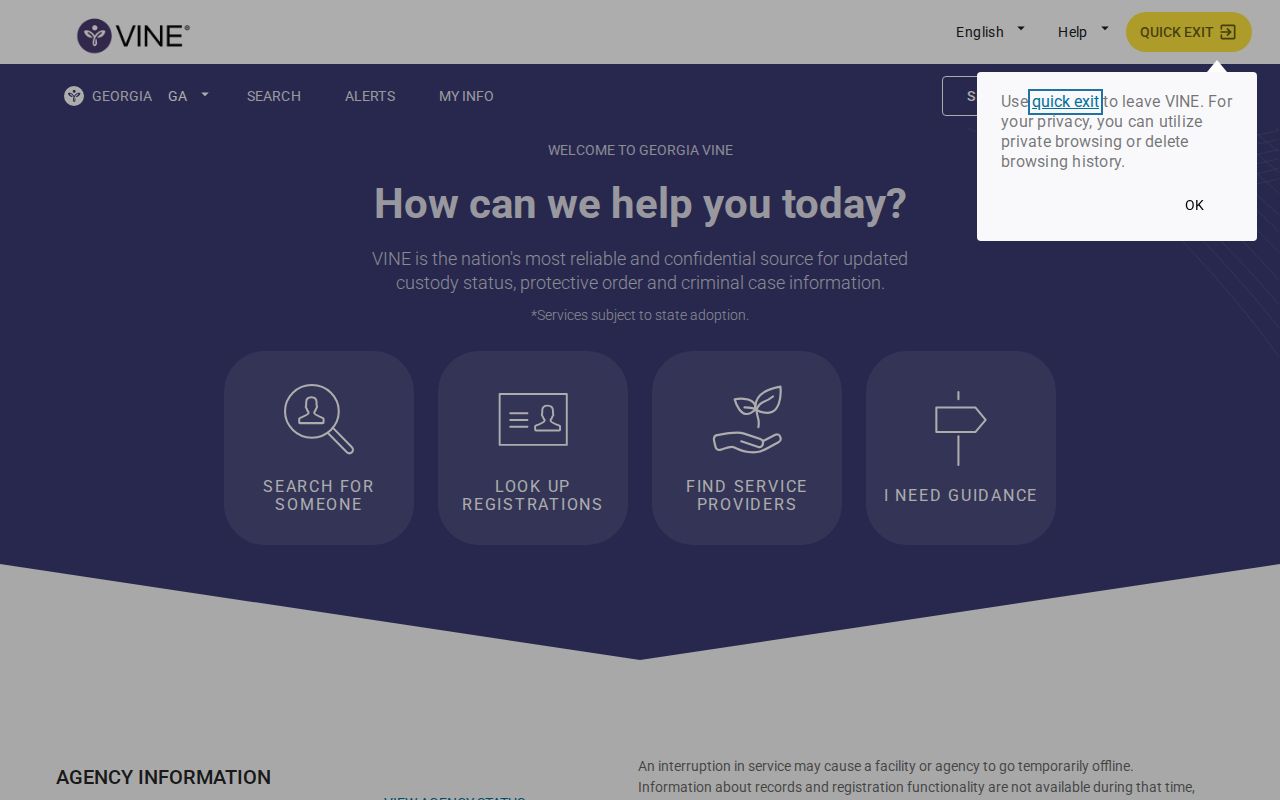
The Georgia screen is the correct starting point for a specific-person search and alert registration, not a local list of everyone recently released.
Grady County VINE Result Fields
The exact fields vary with the participating agency and record. Read the status as a report from that source, not as a court judgment. If a result says released, note the date, time, and facility only when those details are actually displayed.
| Field | What it can show |
|---|---|
| Name or ID | The identity key used to distinguish the record from similar names. |
| Custody status | Whether the source reports the person in custody, released, transferred, or under another stated condition. |
| Facility | The participating jail or prison tied to the current report. |
| Release information | A date, time, or custody-change wording when the source supplies it. |
| Notification option | The control used to register for supported phone, text, or email alerts. |
VINE does not replace the Grady County jail release record. That record may include a booking number, release timestamp, release type, releasing authority, bond details, case number, transfer destination, and holds. Court records may then explain bond, dismissal, sentence, or probation. Each source answers a different question.
Set Grady County Release Alerts
Registration works best while the correct person is still shown in custody. Open that person's record and use the registration or notification control. Select only contact methods the Georgia workflow offers. Exact choices can change, so follow the live labels rather than relying on an old screenshot.
- Confirm the identity and current facility before selecting the notify option.
- Choose phone, text, email, or another method that the live service supports.
- Enter the contact information carefully and complete the confirmation step.
- If a PIN is requested, retain it for confirming calls or managing notices.
- Keep the alert active until the status is confirmed with the responsible agency.
An alert may report release or transfer without explaining the legal reason. Bond, time served, a court order, prison discharge, and transfer to another authority are not interchangeable. Ask the originating office what event its record shows. If a call or message is missed, return to the person record and contact the agency rather than treating silence as proof of custody.
Confirm Grady County VINE Alerts
Agency feed timing can delay a notice. A record can also vanish after release or fail to match an alias. For a Grady County jail case, call the Sheriff's Office at 229-377-5200 and ask how to obtain the booking and release record. The official sources list more than one address for the sheriff, jail, and courthouse setting, so call before visiting.
For a state prisoner, use the GDC Find an Offender page and direct query. The state form includes a “Released In The Past 15 Days” filter for GDC-linked custody, but that filter is not a Grady County jail release list. Written GDC verification goes to Inmate Records and Information, PO Box 1529, Forsyth, GA 31029.
Federal custody requires the BOP locator. Immigration custody requires ICE's official locator. VINE should not be stretched across those systems. A person can leave one agency and enter another, so “released” must always be read with the reporting facility named beside it.
Note: A custody alert can arrive after the actual change because VINE depends on the participating agency's update and transmission schedule.
Grady Release Notification Layers
Georgia has more than one notification layer. VINE handles participating custody changes. The State Board of Pardons and Paroles also describes notifications through its Victim Information Program as part of the parole process. Those channels overlap in subject but not in authority.
A person following a county jail custody change may need VINE and the sheriff. Someone following a state parole decision may need the Board's program, GDC information, and the local DCS supervision channel. The Board's Georgia parole process explains its decision and notification role. A Tentative Parole Month is not a release notice, and a VINE alert is not a parole certificate.
- Custody alert
- A notice that a participating agency reported a status change.
- Release record
- The originating agency's administrative record of when and how custody ended.
- Transfer
- Movement to another authority, which is not freedom from all custody.
- Parole
- Conditional community release from a prison sentence under supervision.
Keeping those terms separate prevents a common error: treating removal from a local jail list as proof that all custody and supervision ended.
Missing Grady County VINE Results
A no-result screen calls for a controlled fallback, not a guess. Search the full legal name, then try an alternate spelling, alias, hyphenated form, or known ID. If the person may have moved, search the agency that could have received custody. A Grady County jail transfer to GDC should be checked in the state offender query. Federal custody belongs in the BOP locator, while an immigration transfer belongs in ICE's locator.
For a local case, ask the sheriff for the booking number, booking time, release time, release type, releasing authority, holds, and transfer destination. Then check the Grady County Clerk of Court for bond, dismissal, sentence, or another order that explains the custody change. These records remain useful when a VINE entry is no longer searchable.
Timing also matters. Registering before release gives the service a chance to send the change reported by the participating agency. Research after release may find less historic detail because VINE is designed for status and notice, not permanent archiving. Keep the notification message, but confirm its meaning with the named agency.